


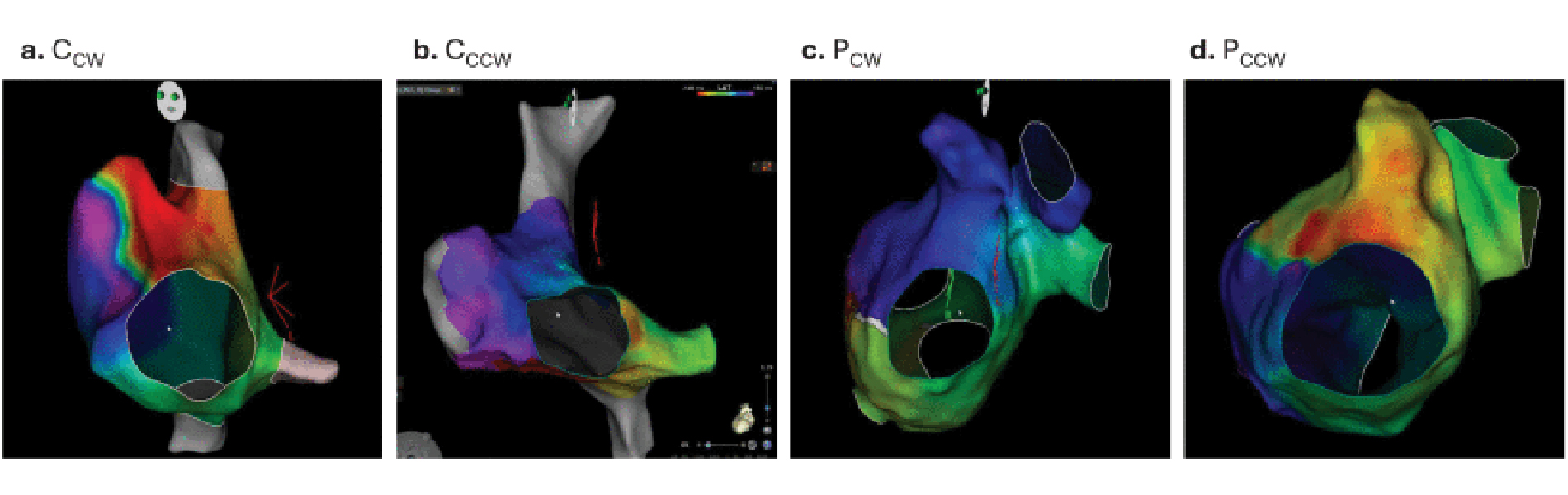
- The study, conducted in collaboration with ETH Zurich and La Paz University Hospital in Madrid, combines data from a conventional 12-lead electrocardiogram with a range of patient-related clinical variables.
Researchers from the EP Analytics LAB group at the ITACA Institute of the Universitat Politècnica de València have contributed to the development of an explainable artificial intelligence (AI) model capable of non-invasively identifying the electrical circuit responsible for atrial flutter, a cardiac arrhythmia in which electrical impulses become trapped in an abnormal circuit.
The research, conducted in collaboration with ETH Zurich and La Paz University Hospital in Madrid, combines information obtained from a conventional 12-lead electrocardiogram (ECG) with various patient-related clinical variables.
Published in the IEEE Journal of Translational Engineering in Health and Medicine, the study demonstrates that the model can estimate the location of the circuit responsible for the arrhythmia and its direction of rotation – two key aspects for guiding cardiac mapping and selecting the most appropriate ablation strategy. Currently, this mechanism is usually confirmed by means of an invasive electrophysiological study.
“Our aim is to extract information from the electrocardiogram that helps specialists anticipate which circuit is causing the arrhythmia before the procedure begins”, explains José Millet, head of the EP Analytics LAB at ITACA-UPV.

Electrocardiograms from 97 patients
The team analysed data from 97 patients who had undergone an electrophysiological study. Using their electrocardiograms, the researchers reconstructed three-dimensional representations of atrial electrical activity and calculated parameters relating to the shape, complexity and propagation speed of the electrical signal.
These characteristics were combined with data such as age, body mass index, history of atrial fibrillation and previous ablations. The model then classified the cases into four types of flutter: two common circuits and two perimitral circuits, each with either clockwise or anticlockwise rotation.
“The multimodal system outperformed models based exclusively on cardiac signals or clinical information. Its main contribution is that it identifies which signal characteristics and clinical variables have the greatest influence on each prediction, making the results easier for healthcare professionals to interpret”, highlights Francisco Castells, a researcher at ITACA-UPV.
Supporting more personalised planning
The methodology could guide mapping towards the most likely circuit, anticipate the complexity of the procedure and improve the efficiency of ablation planning. Its aim is not to replace the electrophysiological study, but to provide a tool to support clinical decision-making.
“The innovative nature of this work lies in the combination of clinical data with interpretable electrophysiological parameters, such as circuit geometry, the speed of electrical activity propagation, or the presence of potential areas of slow conduction”, conclude the ITACA researchers.
The next steps will focus on validating the system with a larger number of patients and through multicentre studies. The team will also develop methods to automatically extract atrial activity without administering adenosine.