



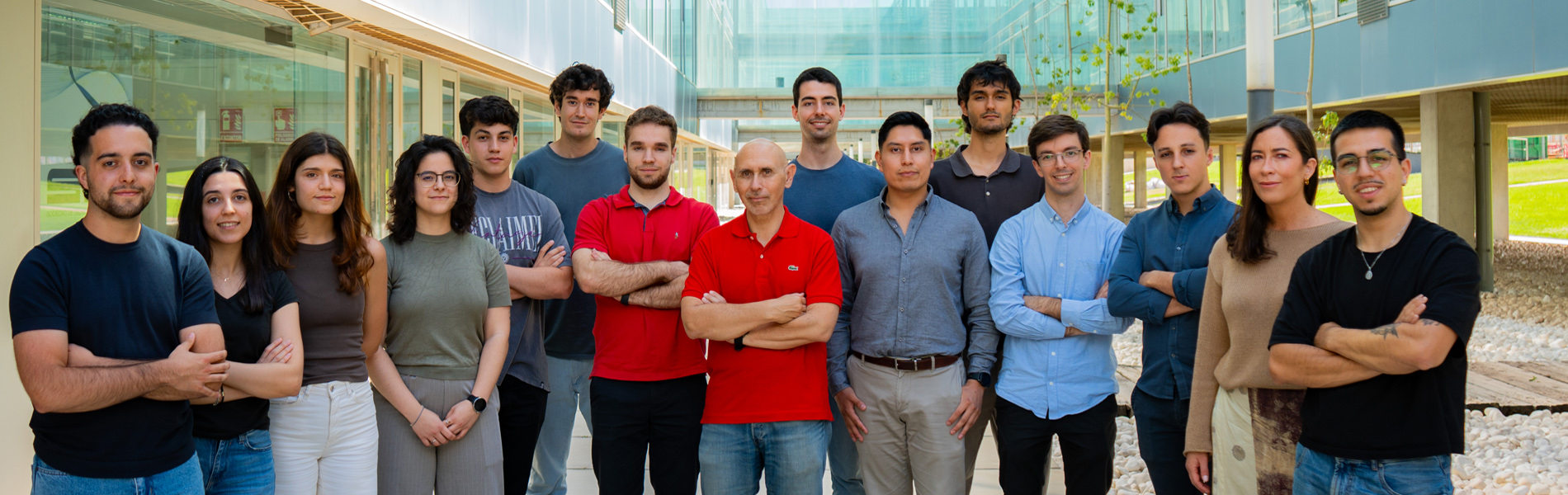
The SNA (Air Navigation Systems) group of the ITACA Institute at the Universitat Politècnica de València (UPV) has achieved five projects under the SESAR Joint Undertaking–Horizon Europe programme, focused on the development of advanced technologies for air traffic management and drone traffic management (U-space).
This result consolidates the group’s position as one of Europe’s leading references in research on the digitalisation and automation of airspace.
Led by Juan Vicente Balbastre, Professor at UPV, the grant of these projects reflects the team’s scientific and technological maturity, as well as its ability to lead applied research in a strategic field for the future of aviation, fully aligned with the priorities of the European Union.
“U-space is a European framework of digital services and procedures designed to manage drone operations in low-altitude airspace automatically and safely, particularly in urban environments. Its objective is to ensure the efficient coexistence of manned and unmanned aircraft, while enabling the development of new services and air mobility models», explains Juan Vicente Balbastre.

Projects granted
In the DiFeRent project, coordinated by EUROCONTROL (Belgium), the SNA group will contribute to advancing the concept of Digital Flight Rules (DFR), aimed at facilitating the safe and highly automated integration of new airspace users.
In HIVE, coordinated by Flyfire srl (Italy), the research will focus on U-space operations involving drone fleets and swarms, incorporating key aspects of safety, verification and solution scalability.
The RAXUS project, coordinated by ENAIRE (Spain), will address the development of risk-based authorisation and execution mechanisms aimed at delivering efficient, equitable U-space services tailored to different operational profiles.
In DAEDALUS, coordinated by TOPVIEW srl (Italy), research will focus on dynamic airspace stratification and altitude integrity, based on a common reference framework and robust system safety monitoring.
Finally, in U-EXPAND, the group will participate in the development and validation of advanced CNS (Communication, Navigation and Surveillance) capabilities for U3 U-space services, including the use of public 5G networks as dual-purpose infrastructure for safe and efficient air operations.
For all these reasons, the ITACA researcher highly values this achievement, which further strengthens the group’s position at the forefront of European U-space research.
“The award of these projects demonstrates the strength of our scientific programme, our capacity for international collaboration, and the tangible impact of the research we carry out on the evolution of the European air traffic management system,” concludes Juan Vicente Balbastre.