




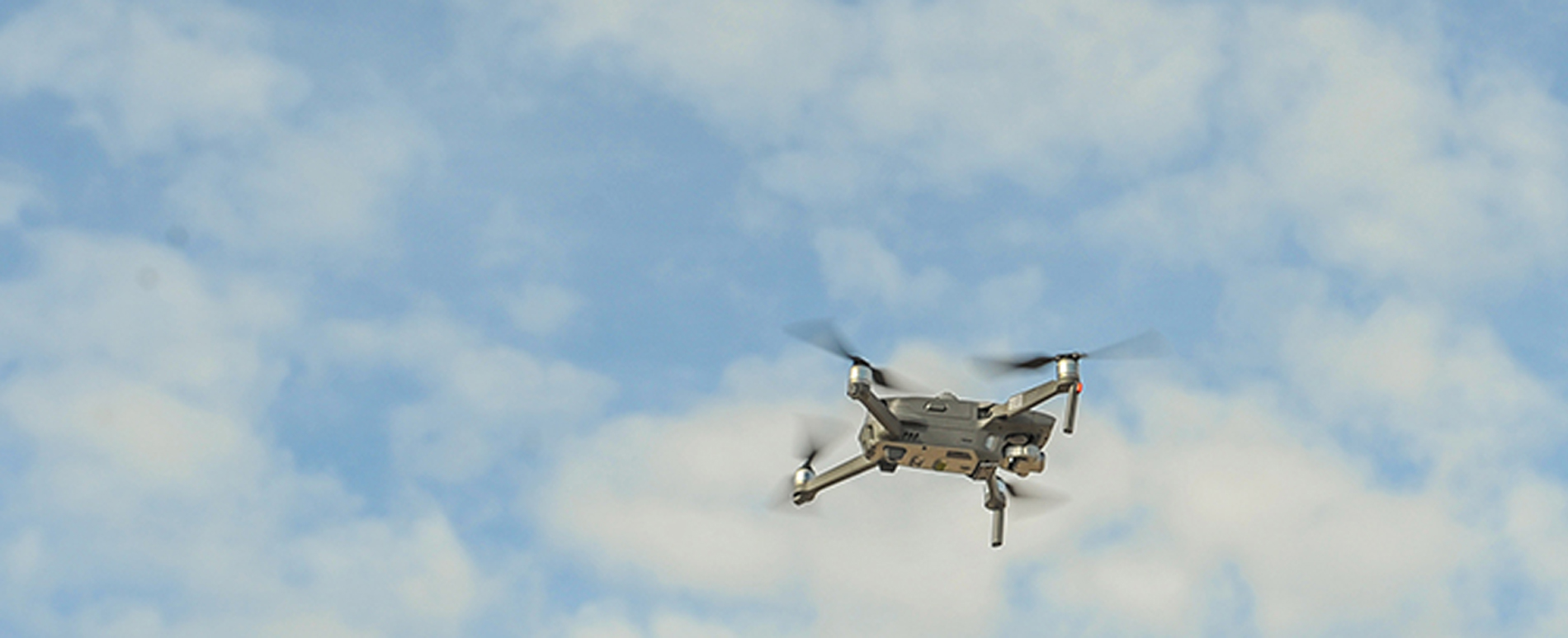
Researchers from the Universitat Politècnica de València (UPV)—members of the SNA group at the ITACA Institute and the ITEAM Institute—have designed and validated an innovative radar antenna prototype to prevent collisions between unmanned aerial systems (UAS), such as drones.
Thanks to its compact aerodynamic profile and 3D-printed aluminium structure fabricated using Selective Laser Melting (SLM) technology, the antenna can be seamlessly integrated into small drones without affecting their flight performance or safety.
The team demonstrated the system’s effectiveness through a combination of numerical simulations and tests conducted in an anechoic chamber. Weighing just 163 grams, the prototype could detect large aircraft at 600 metres and small drones at 60 metres, thereby meeting the applicable European standards for this type of system.
Furthermore, the antenna employs low-cost commercial components, bringing its estimated production cost to just €200 per unit—making it especially attractive for widespread adoption in drone technology.
An important advance for U-space
One of the key features of the antenna—developed by Javier Ruiz Alapont and Juan Vicente Balbastre (SNA–ITACA) in collaboration with Miguel Ferrando-Bataller (ITEAM)—is its 360° coverage, making it a crucial component for U-space, the European framework for unmanned traffic management.
“This solution overcomes major limitations of current radar antennas for UAS, offering a wider field of view, improved power handling, and reduced mechanical complexity and cost. Its development is particularly relevant for urban drone operations governed by the U-space framework”, explain the UPV researchers.
The ITACA–ITEAM team from UPV also highlights that the prototype is ready for the next stage: integration into complete onboard radar systems.
“Our design improves the way for more effective, lightweight, and affordable collision-avoidance systems—essential for the safe deployment of drones in shared airspace,” concludes Professor Juan Vicente Balbastre, principal researcher of the study.
Noticia elaborada por ITACA FORWARD, financiada por Ivace+i Innovación y la Unión Europea a través del Programa Fondo Europeo de Desarrollo Regional (FEDER) Comunitat Valenciana 2021-2027 (Referencia del proyecto: INNVA2/2025/17)
