




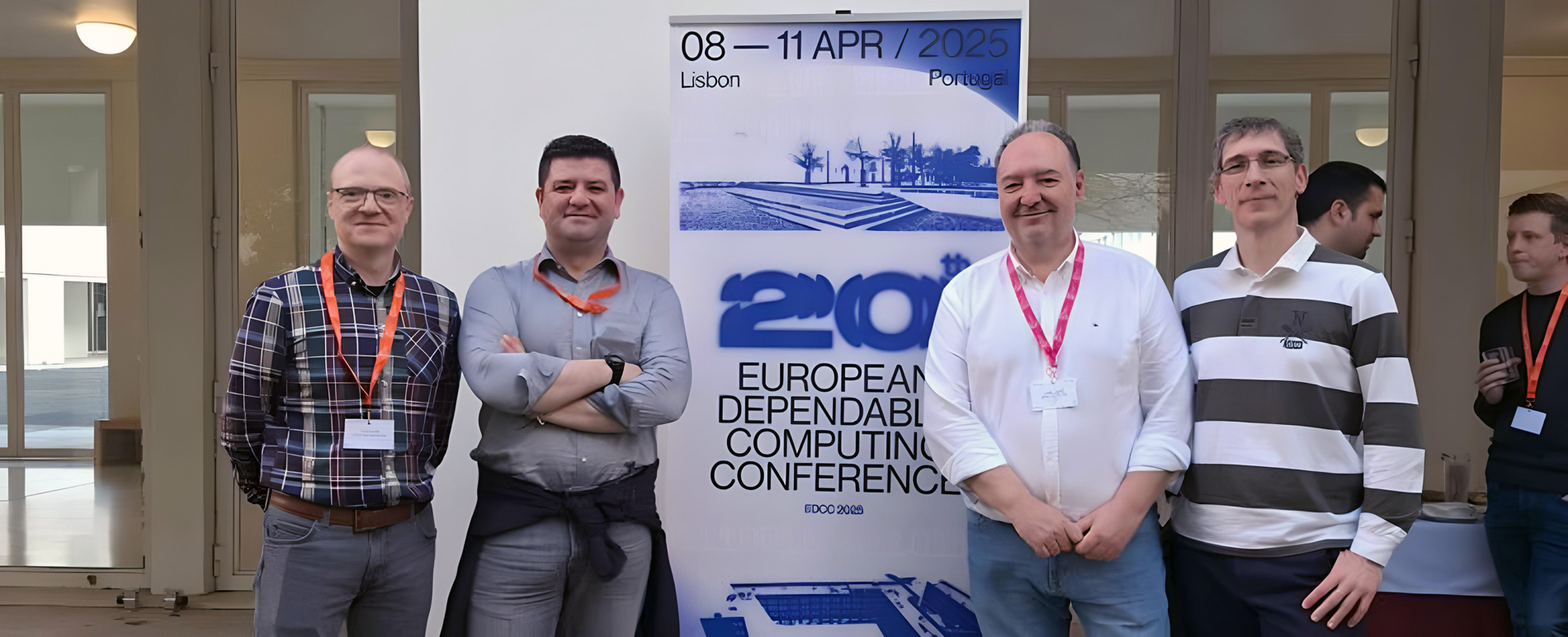
The Fault-Tolerant Systems Group from the ITACA Institute (UPV) played a prominent role in the 20th edition of the European Dependable Computing Conference (EDCC), which was recently held in Lisbon. This conference is one of the leading international forums in the field of dependable computing, addressing key topics such as cybersecurity, data privacy, and fault tolerance in critical systems.
During the event, the group’s researchers presented several oral communications and scientific posters focusing on advances from the national project the DEFADAS (Dependable-enough FPGA-Accelerated DNNs for Automotive Systems). The presentations covered three main lines of research:
- Enhance the robustness and reliable of deep neural networks (CNNs and QCNNs) when their execution is accelerated using dedicated hardware such as FPGAs.
- Design and evaluate new fault-tolerance strategies, including error injection methodologies, early detection, and mitigation through techniques such as runtime reconfiguration.
- Optimise hardware resource usage, exploring low-precision numerical formats—such as a novel 8-bit floating-point format—and employing tools like High-Level Synthesis (HLS), all without compromising accuracy or performance.
Distinguished Poster Awards
A highlight of the conference was the recognition of Luis José Saiz, who received one of the three Distinguished Poster Awards (out of 22 presented works) for his contribution: “Towards a novel 8-bit floating point format to increase robustness in CNNs”.

This work proposes a new 8-bit floating-point format to represent the parameters of convolutional neural networks (CNNs) more efficiently and robustly. Compared to traditional formats such as FP32, BF16, or even other existing 8-bit formats, this proposal introduces a variable-length exponent, allowing the range and precision to be more closely tailored to the actual data requirements.
Additionally, Juan Carlos Ruiz and David de Andrés were members of the conference organising committee, serving as Steering Committee Chair and Programme Chair, respectively.
This edition of EDCC further consolidates the ITACA Institute’s standing as an international benchmark in the development of intelligent and dependable systems for critical applications.