



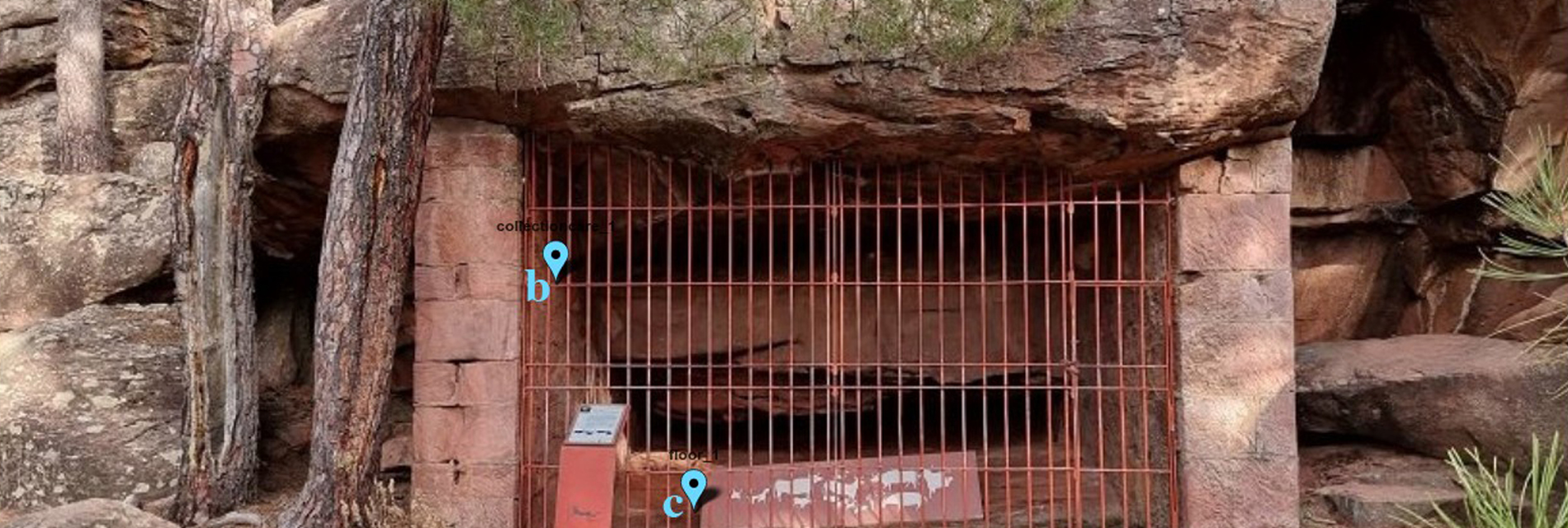
A team from the ITACA Institute of the Universitat Politècnica de València (UPV) has developed an innovative real-time environmental monitoring system to conserve Levantine rock art in the Albarracín Cultural Park (Teruel). Its development also involved collaboration with the Department of Conservation and Restoration of Cultural Heritage of UPV and the University of Zaragoza.
The work, published in the scientific journal npj Heritage Science (Nature), was led by ITACA researcher Ángel Perles, within the framework of the WiMOSA project (Wireless non-stop Monitoring System for heritage Safeguard), funded by the Ministry of Science, Innovation and Universities.
More sustainable and effective conservation
The system has been implemented at the Toros del Prado del Navazo rock shelter, one of the most representative enclaves of post-Paleolithic rock art. By integrating IoT (Internet of Things) technology, the device enables continuous monitoring of environmental conditions—such as temperature, relative humidity, and UV radiation—that affect prehistoric paintings.
Among the main results of the study is a 75% reduction in annual CO₂ emissions, decreasing from 197.2 to 49.3 kg of CO₂eq, thanks to fewer trips required for data collection. Likewise, the system minimizes interruptions in monitoring, reducing them from 36% with traditional data loggers to 5.9%, and improves data availability to 94.1%, compared to 64% obtained with conventional devices.
“The system allows us to precisely identify thermal and humidity fluctuations responsible for degradation processes of the rock support and the paintings, thus facilitating more effective planning of preventive interventions», highlights Ángel Perles, lead author of the study.
Technological innovation at the service of heritage
To enable continuous data transmission in a remote environment, the ITACA UPV team has developed the first open LoRaWAN network installed at a rock art site, powered by solar energy and providing coverage for other nearby shelters, such as Cocinilla del Obispo and Tío Campano.
“Our open-access wireless model allows community participation, facilitates scalability, and promotes long-term sustainability”, emphasizes Ricardo Mercado, an ITACA researcher involved in the study.
The sensors have been camouflaged using hydrographic printing techniques to minimize visual impact. They are installed without contact with painted surfaces, in accordance with the principles of reversibility and respect for heritage established by ICOMOS.
“The system is integrated into a digital dashboard that allows real-time visualization of the evolution of environmental parameters and the receipt of automatic alerts in the event of possible anomalies, such as increases in humidity or transmission failures», indicates the researcher from the ITACA Institute.
A replicable and sustainable model
According to the coordinators of this work, the system could be replicated and scaled to other heritage sites exposed to extreme environmental conditions.
“Thanks to real-time monitoring, we can better understand deterioration factors and act preventively. In addition, we reduce travel and emissions, contributing to more sustainable conservation», concludes Ángel Perles.
REFERENCE
Perles, A., Zalbidea-Muñoz, A., Serrano Aranda, C., & Mercado, R. (2025). Remote monitoring of rock art shelters: an innovative application in the Cultural Park of Albarracín. npj Heritage Science. DOI: 10.1038/s40494-025-02123-w
Noticia elaborada por ITACA FORWARD, financiada por Ivace+i Innovación y la Unión Europea a través del Programa Fondo Europeo de Desarrollo Regional (FEDER) Comunitat Valenciana 2021-2027 (Referencia del proyecto: INNVA2/2025/17)
